 Kadodi Media House Your media place
The former Umuyinga of Bugisu, Y. B. Mungoma, wrote to local leaders in Mbale and Sironko districts calling for renewed unity among the Bamasaba people and the establishment of a joint cultural leadership body to preserve tribal identity and promote cohesion.
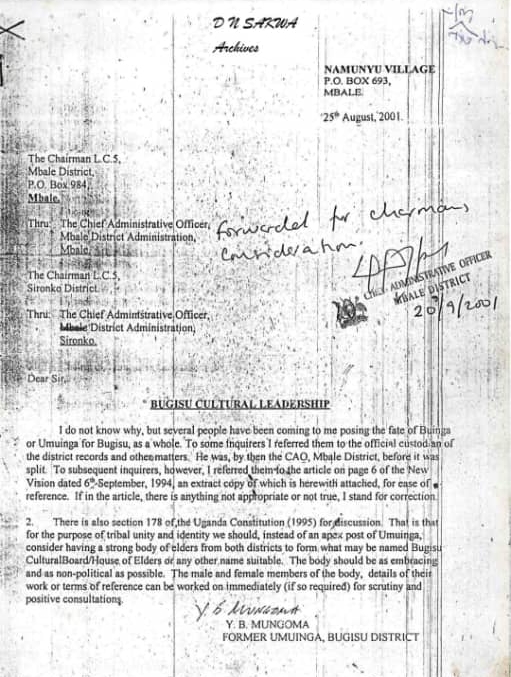
In a letter dated 25th August 2001 and copied to the Chairmen L.C.5 of Mbale and Sironko districts through their respective Chief Administrative Officers, Mungoma expressed concern over the continued confusion surrounding the fate of the traditional Bugisu leadership following the administrative split of the districts.
He noted that many residents had approached him seeking clarification on the cultural leadership question particularly the role and position of the Umuyinga or Umuinga for Bugisu as a whole. Mungoma referred inquiries to the existing district records and relevant articles previously published on the subject but emphasized the need for a more structured approach to cultural affairs.
Citing Section 178 of the 1995 Uganda Constitution, Mungoma proposed the formation of a Bugisu Cultural Board or House of Elders, comprising respected men and women from both districts. He explained that the body would act as a unifying cultural institution for all Bamasaba, ensuring that tribal identity and unity were maintained beyond district boundaries.
“For the purpose of tribal unity and identity, we should, instead of an apex post of Umuyinga, consider having a strong body of elders from both districts,” Mungoma wrote. “The body should be as embracing and as non-political as possible.”
He further recommended that the members of the proposed council define clear terms of reference, working structures, and operational guidelines through inclusive consultations.
The letter, received and stamped by the Mbale District Administration on 20th September 2001, was officially forwarded for consideration by the District Chairman.
Mungoma’s call for a Bugisu Cultural Board came at a time when Bugisu’s traditional and political leaders were grappling with questions of identity, leadership legitimacy, and the preservation of Bamasaba heritage following the creation of new administrative units.
The proposed council, if implemented, would serve as a forum for unity, cultural preservation, and reconciliation among the Bamasaba people across district lines.
By. REAGAN NABUTELE