 Kadodi Media House Your media place
By Our Staff Reporter
Mbale-Uganda-March 30, 2026-A fresh wave of controversy has engulfed the Inzu Ya Masaaba Cultural Institution following statements attributed to the Attorney General of the Umukuuka wa Bugisu, Richard Masereje, with critics accusing him of promoting legally flawed and culturally misleading interpretations regarding the governance of the institution.
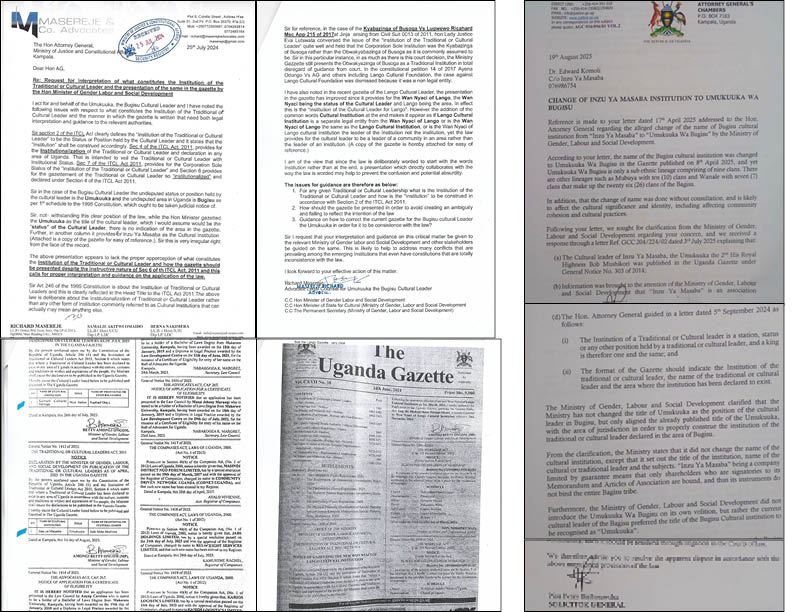
The dispute intensified after the Government Solicitor General reportedly denied any state involvement in alleged changes to the institution’s name or structure—contradicting claims circulating within certain factions. This development has deepened confusion and heightened tensions across the BaMasaaba community.
At the center of the controversy are assertions that the long-established mechanism of leadership selection through the 26 clan representatives is “invalid” or “non-existent,” alongside sweeping claims that “everything was cancelled.” These remarks have triggered strong backlash from cultural stakeholders and constitutional analysts.
The 26-Clan System: Core of Legitimacy
Cultural leaders and scholars emphasize that the 26-clan voting structure forms the foundation of the Inzu Ya Masaaba institution. The Inzu, as the umbrella cultural body, derives its authority from the collective will of the clans, each represented by delegates entrusted with safeguarding tradition, identity, and governance.
“To dismiss this system is to undermine the very existence and mandate of the institution,” one elder noted. “Without the clans, there is no Inzu. Without Inzu, there is no Umukuuka.”
Constitutional Interpretation Dispute
Legal experts have pointed to provisions within the Constitution of Uganda—particularly Article 246—as being selectively interpreted.
Article 246(3)(a) establishes that a traditional or cultural leader is a “corporation sole,” with legal capacity to sue and be sued, affirming that the institution itself has legal standing. This means the Inzu, as a corporate cultural body, can lawfully challenge or hold its leadership accountable in court.
Further, Article 246(6) defines a traditional leader as one who derives legitimacy either through lineage or through “the consent of the people led.” In Bugisu, analysts argue, that consent is concretely expressed through the 26 clan representatives.
“If the clans are declared void, then where does the consent come from?” one analyst questioned. “The Constitution is explicit—authority must be rooted in the people.”
Government Position
Adding a critical dimension to the dispute, the Government Solicitor General clarified that there has been no officially sanctioned state process to alter the name, structure, or legal standing of Inzu Ya Masaaba.
This position challenges narratives suggesting official backing for the alleged “demise” or restructuring of the institution. Legal observers note that without formal government action, parliamentary amendment, or a competent court ruling, any claim of institutional cancellation remains legally untenable.
Rejection of Hereditary Claims
Another contentious issue is the reported use of titles such as “King of Bugisu,” which cultural experts have condemned as historically inaccurate.
Unlike monarchies based on hereditary succession, BaMasaaba leadership is not determined by birthright. The position of Umukuuka is a term-limited office, entrusted through a structured and representative process.
“Bugisu has no kingship tradition,” a cultural historian explained. “Leadership here is earned through consensus, not inherited.”
Institutional Clarification
Observers stress the need to distinguish between the institution and the office holder:
Inzu Ya Masaaba – the cultural institution composed of clan delegates
Umukuuka – the head of the institution serving within defined limits
“The institution is not the Umukuuka,” one commentator emphasized. “The Umukuuka serves the institution—not the other way around.”
Legal and Cultural Concerns
The claims attributed to Richard Masereje are now under scrutiny for both cultural and legal consistency. Critics argue that declaring established governance structures null without due process risks contravening constitutional principles and customary law.
Additionally, the statement that “everything was cancelled” has been described as vague, unsupported, and lacking any identifiable legal basis.
“There is no known legal instrument, court ruling, or constitutional provision that has dissolved the Inzu or its structures,” a legal analyst said. “Such claims amount to misinformation.”
Calls for Clarity
Community leaders are calling for accountability, urging legal officers within the institution to provide clear and evidence-based interpretations rather than politically influenced narratives.
The unfolding situation highlights the need to safeguard cultural institutions, ensure adherence to constitutional frameworks, and preserve the integrity of traditional governance systems.
As tensions escalate, observers warn that any attempt to redefine or dissolve the governance framework of Inzu Ya Masaaba without respecting its foundational principles risks both legal contradiction and cultural fragmentation.
“Tradition is not imagination,” one elder remarked. “It is lived history, structured authority, and collective consent. You cannot cancel it with words.”
The debate continues, but for many within the BaMasaaba community, the line has been clearly drawn between constitutional reality and what they describe as growing misrepresentation.