 Kadodi Media House Your media place
By Our Staff Reporter
Kampala/Fort Portal | 13 September 2026
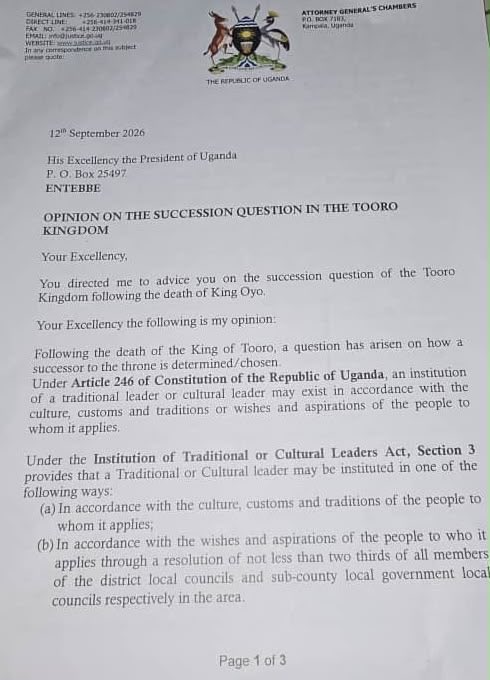
President Yoweri Kaguta Museveni has received a significant legal opinion from Uganda’s Attorney General, Dr Sam Mayanja, on the increasingly contested succession to the Tooro Kingdom throne following the death of Omukama Oyo Nyimba Kabamba Iguru Rukidi IV.
The three-page opinion, dated 12 September 2026 and addressed to the President, places the late King Oyo’s will at the centre of the succession question and advises that its validity can only be challenged before a court of law.
AG: KING OYO’S WILL SHOULD BE FOLLOWED
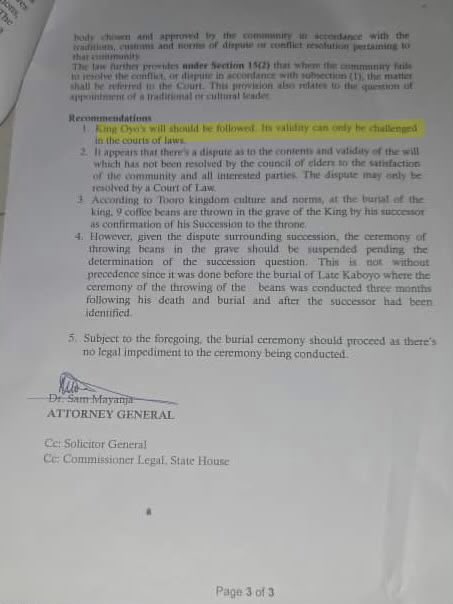
The strongest conclusion in the Attorney General’s opinion appears under the recommendations:
“King Oyo’s will should be followed. Its validity can only be challenged in the courts of law.”
This advice is particularly significant because Prince Edward Rukidi Kijanangoma had already been selected by a 21-member Babiito succession committee amid objections from members of King Oyo’s immediate family, who maintained that the deceased monarch had left a will governing succession.
The Attorney General’s intervention therefore does not by itself constitute a court judgment removing or confirming any claimant. Rather, it sets out the Government’s chief legal adviser’s interpretation of the applicable law and the mechanism through which the unresolved dispute should be determined.
WHAT KING OYO’S WILL reportedly PROVIDES
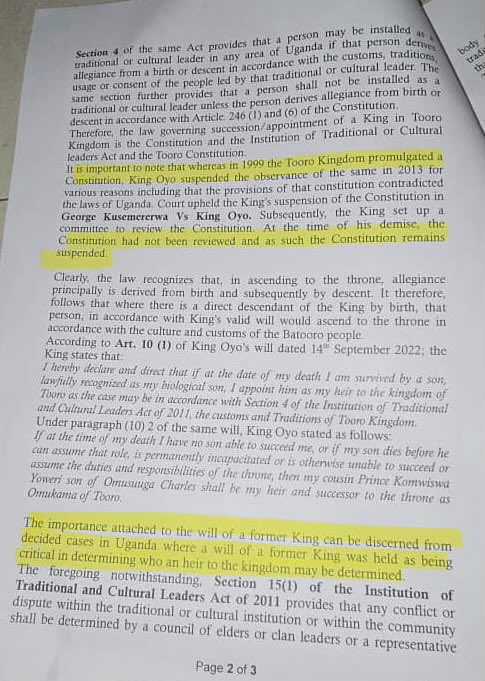
According to the Attorney General’s opinion, King Oyo’s will, dated 14 September 2022, provides that if he were survived by a son lawfully recognised as his biological son, that son would be appointed heir to the Kingdom of Tooro in accordance with the Institution of Traditional or Cultural Leaders Act and Tooro customs.
The opinion further states that where there was no son able to succeed—or where such a son was permanently incapacitated or otherwise unable to assume the role the will provided an alternative line of succession, including Prince Komwiswa Yoweri, son of Omusuuga Charles. Contemporary reporting on the will has similarly described a succession chain established by the late King.
This makes the existence, recognition and legal status of the alleged biological son a potentially crucial factual issue in the dispute.
LAW PUTS CUSTOM, COMMUNITY AND COURTS AT THE CENTRE
The Attorney General refers to Article 246 of the Constitution and the Institution of Traditional or Cultural Leaders Act, 2011.
His opinion notes that Uganda’s law recognises culture, customs, traditions and the wishes and aspirations of the relevant community in establishing and determining traditional or cultural leadership.
Importantly, Section 15 of the Act provides a dispute-resolution mechanism. Disagreements within a traditional institution—including disputes over who should be the cultural leader—are first to be handled through recognised community mechanisms involving elders, clan leaders or an appropriate representative body. Where the community process fails to resolve the conflict, the dispute can be referred to court. Government had publicly emphasised the same legal framework before King Oyo’s burial.
The Attorney General concludes that because the dispute over the contents and validity of the will had not been resolved to the satisfaction of the community and all interested parties, the outstanding dispute may ultimately require determination by a court of law.
THE QUESTION OF TOORO’S 1999 CONSTITUTION
Another important element of the Attorney General’s opinion concerns the 1999 Tooro Kingdom Constitution.
According to the document, King Oyo suspended observance of that constitution in 2013 after concerns that some of its provisions contradicted Ugandan law. The Attorney General refers to litigation arising from that decision and states that a committee was subsequently established to review the constitution.
The opinion says that the review had not been completed by the time of King Oyo’s death and therefore treats the constitution as remaining suspended.
This issue matters because the succession dispute cannot be examined only through the lens of one institutional document; the Attorney General instead grounds his advice in the national Constitution, the 2011 Act, Tooro customs and the late King’s will.
COFFEE-BEAN SUCCESSION RITUAL BECOMES LEGALLY SENSITIVE
One of the most consequential recommendations concerns an important Tooro royal ritual.
According to Tooro tradition described in the Attorney General’s opinion, the successor throws nine coffee beans into the grave of the deceased King during burial as confirmation of succession.
The Attorney General recommended that, given the unresolved dispute, this particular succession ritual should be suspended pending determination of the succession question.
The opinion cited historical precedent involving the burial of the late King Kaboyo, when the ritual was reportedly conducted months after burial once the successor had been identified.
However, Reuters reported that Edward Rukidi Kijanangoma formally assumed power during Saturday’s burial ceremonies by casting nine coffee berries into King Oyo’s grave.
That sequence of events creates an important question for further legal and cultural scrutiny: what is the effect of a succession ritual performed while the underlying succession remains contested and after the Attorney General had advised that the ritual be suspended
BURIAL ITSELF HAD NO LEGAL IMPEDIMENT
The Attorney General made an important distinction between the succession dispute and the burial of the late King.
His fifth recommendation states that, subject to the succession concerns raised, the burial ceremony should proceed because there was no legal impediment to conducting it.
King Oyo was subsequently laid to rest at the Karambi Royal Tombs on Saturday, 12 September.
A NATIONAL TEST FOR CULTURAL GOVERNANCE
The Tooro dispute now extends beyond the identity of an individual successor. It raises wider national questions about how Uganda reconciles traditional customs, royal family arrangements, written wills, community institutions and the constitutional framework governing cultural leadership.
Traditional and cultural institutions remain important parts of Uganda’s social and historical fabric, but they operate within the constitutional order. The handling of the Tooro transition may therefore establish an influential precedent for how future disputes in Uganda’s cultural institutions are managed.
The Attorney General’s advice points toward a restrained approach: respect the late King’s expressed wishes, use recognised cultural mechanisms, and where those mechanisms cannot produce an accepted settlement, allow the courts to determine the legal dispute.