 Kadodi Media House Your media place
 From an Ancient Royal Dynasty to a Modern African Monarch
By Our Staff Reporter
UGANDA – Wednesday 9th September 2026
There are lives measured simply in years, and there are lives measured in the history they carry.
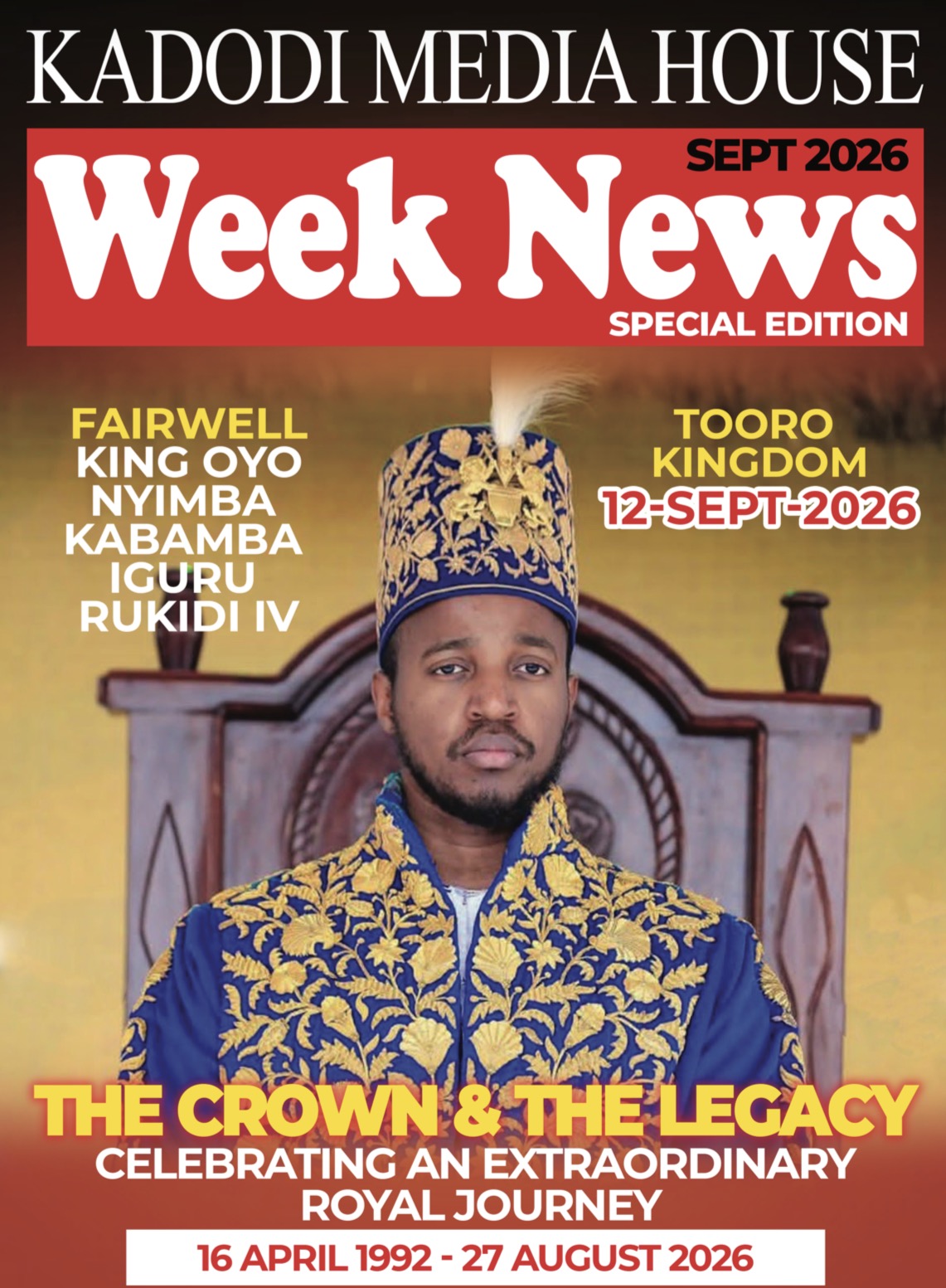
His Royal Majesty Rukirabasaija Omukama Oyo Nyimba Kabamba Iguru Rukidi IV belonged to the latter.
Born on 16 April 1992 and called to the throne at only three years old, King Oyo spent nearly his entire life carrying the crown, identity and aspirations of the people of Tooro. His death on 27 August 2026, at the age of 34, closed an extraordinary chapter in Uganda’s cultural history.
Yet his story did not begin with his birth. It was part of a royal heritage stretching back generations, to the founding of the Tooro Kingdom itself in the nineteenth century — and to understand Oyo, one must first understand the throne he inherited.
The Roots of the Tooro Kingdom
The history of Tooro is inseparable from the wider history of the ancient kingdoms of the Great Lakes region. The modern Tooro Kingdom traces its establishment to the early nineteenth century, when Prince Kaboyo broke away from Bunyoro-Kitara to found an independent kingdom, becoming Kaboyo Olimi I.
From those beginnings emerged a royal institution that survived succession struggles, colonialism, Uganda’s transition to independence, the abolition of traditional kingdoms in 1967, and their eventual restoration in 1993. King Oyo therefore inherited far more than a palace and a title he inherited an institution with a proven capacity to survive political and social upheaval.
The Royal Ancestors
Among the monarchs who shaped the modern dynasty was Omukama Daudi Kasagama Kyebambe, whose reign from 1891 to 1928 coincided with sweeping political and religious change in Tooro. Kasagama’s era helped consolidate the Kingdom through the colonial period, and it was during his reign that Christianity became deeply established in Tooro — beginning a relationship between the monarchy and the Church that would continue for generations.
He was followed by Omukama Sir George David Matthew Kamurasi Rukidi III — King Oyo’s grandfather.
Sir George Rukidi III: The Grandfather
Rukidi III reigned from 1928 until his death in 1965, bridging two starkly different eras: colonial Uganda and the birth of an independent Ugandan state. He represented Tooro on the world stage, attending the coronation of Queen Elizabeth II in London in 1953 an early symbol of the international connections the Tooro royal household would come to be known for.
Under Rukidi III, the monarchy became an important bridge between traditional authority and the emerging modern state. His family also produced some of Uganda’s most internationally recognised figures, notably Princess Elizabeth Bagaaya of Tooro, whose distinguished career spanned law, diplomacy, politics and international public service — a tradition of global engagement that would later define King Oyo’s own reign.
King Patrick Kaboyo Olimi III: The Father Who Restored the Crown
Sir George Rukidi III was succeeded by his son, King Patrick David Matthew Kaboyo Rwamuhokya Olimi III King Oyo’s father who assumed the throne in 1965. But Uganda was entering a turbulent political period. In 1967, traditional kingdoms were abolished, and the Tooro monarchy ceased to exercise its recognised cultural functions. Olimi III spent years away from his throne, and his life became instead an important bridge between royalty and national public service; he went on to serve Uganda diplomatically, including as the country’s Ambassador to Cuba.
When Uganda restored its traditional institutions in 1993, Olimi III returned to the throne a historic homecoming. Tooro had regained its Omukama. But the restored reign was tragically short: on 26 August 1995, King Olimi III died suddenly, leaving his young son to inherit an extraordinary responsibility.
The Birth of Prince Oyo
Oyo Nyimba Kabamba Iguru was born on 16 April 1992 to King Patrick Kaboyo Olimi III and Queen Best Kemigisa. Few could have imagined that within three years, the young prince would become one of the most famous child monarchs in modern history.
Following his father’s death, the ancient mechanisms of royal succession were activated. On 12 September 1995, three-year-old Prince Oyo ascended the throne as Rukirabasaija Omukama Oyo Nyimba Kabamba Iguru Rukidi IV. Images of the tiny king seated upon a throne many times his size travelled around the world. The world saw a child; Tooro saw continuity. The crown had passed from father to son.
Growing Up With a Crown
King Oyo’s childhood was unlike that of almost any other child — he had to become, simultaneously, a pupil, a son, a brother and a king. Because of his young age, senior members of the royal family and the Kingdom establishment played important roles in guiding the monarchy as he grew and was educated.
Queen Mother Best Kemigisa became one of the most important stabilising figures around the young monarch, while Princess Elizabeth Bagaaya one of Africa’s most accomplished royal personalities brought experience, internationalism and dignity to the household. His sister, Princess Ruth Nsemere Komuntale, likewise remained a central figure in the royal family. Oyo’s childhood thus unfolded within a network of family, royal advisers and cultural custodians who understood they were preparing not merely a child, but the future custodian of an ancient institution.
Education: Preparing a Modern King
King Oyo was educated both in Uganda and abroad. His journey took him through Aga Khan Primary School and international schooling before he proceeded to the United Kingdom, where he studied Business Management at the University of Winchester, graduating in 2013.
Education mattered because the world into which he was growing was dramatically different from that of his ancestors. A twenty-first-century cultural leader needed to understand not only tradition, but also economics, management, diplomacy, communications, technology and international relations and King Oyo increasingly embodied that fusion, wearing the royal regalia of his ancestors while speaking to modern questions of education, investment, tourism, public health, climate change and youth empowerment.
From Child King to Working Monarch
As King Oyo matured, the image of the child monarch gradually gave way to that of a confident cultural leader, and his reign increasingly focused on positioning Tooro as a Kingdom proud of its traditions but open to the modern world. His major areas of public engagement included education, youth empowerment, culture and heritage, tourism, environmental conservation, HIV/AIDS awareness, women’s and girl-child advancement, peace building, international cultural diplomacy, and economic development.
Rather than attempting to recreate the political monarchy of previous centuries, King Oyo showed how a modern African traditional institution could exercise influence through culture, convening power, advocacy and development partnerships.
King Oyo and Uganda
King Oyo’s reign unfolded within Uganda’s constitutional framework, where traditional and cultural leaders occupy important cultural roles while remaining outside partisan politics and his relationship with the Government of Uganda carried considerable significance. President Yoweri Kaguta Museveni had been central to the restoration of Uganda’s traditional institutions in the 1990s and maintained a long association with the Tooro royal family. Over the years, national leaders, government officials, diplomats, religious leaders and representatives of other cultural institutions regularly took part in Tooro’s major royal ceremonies, and King Oyo’s coronation anniversaries became national cultural events in their own right, drawing participants from across Uganda and beyond.
His ability to remain a symbol of cultural identity while operating within the wider Ugandan nation was central to his leadership — proof that cultural identity and national citizenship need not compete, but can complement one another.
A King of the Young Generation
One of King Oyo’s greatest advantages was his youth. He understood a generation dramatically different from his grandfather’s — one shaped by smartphones, social media, international travel, global popular culture, entrepreneurship and digital communication, yet still searching for identity and connection with its heritage. King Oyo stood at that intersection. His very presence carried a powerful message: that embracing modernity does not require abandoning culture, and that a young African could participate confidently in the global community while remaining deeply rooted in history.
The Global Ambassador
Over time, the young king transformed the international curiosity that had surrounded his childhood coronation into a platform for advocacy. King Oyo became associated with global efforts against HIV/AIDS and was recognised by UNAIDS for his work — using his position to encourage young people toward prevention, testing, responsible behaviour and the elimination of stigma. It marked an important shift in how royal influence was used: not simply for ceremony, but for public health.
His international engagements also carried Tooro’s name far beyond western Uganda. The Kingdom’s official record highlights his peace advocacy and his recognition as a United Nations Global Peace Ambassador — through which Oyo increasingly became not simply the King of Tooro, but an African cultural ambassador.
Royal Diplomacy
King Oyo understood one of the oldest strengths of traditional institutions: relationships. Governments change and political administrations change, but cultural relationships can survive generations. Throughout his reign, the Tooro monarchy maintained ties with other cultural institutions in Uganda, African royal houses, international organisations, governments and diaspora communities, and King Oyo’s engagements across Europe, Africa and the United States gave the Tooro name considerable global visibility.
The royal family’s historic international connections from Rukidi III’s generation, through Princess Elizabeth Bagaaya, to Olimi III’s diplomatic career — were carried forward by Oyo in a new form. His diplomacy was cultural rather than political, and therein lay its strength.
King Oyo and African Cultural Leadership
King Oyo consistently promoted peaceful relationships among traditional and cultural leaders. Africa is home to hundreds of historic kingdoms, chiefdoms and cultural institutions that, properly organised, represent an enormous network capable of supporting peace building, cultural preservation, tourism, environmental conservation and community development. King Oyo recognised this potential, and his vision of bringing kings and traditional leaders together demonstrated that African royalty can be relevant beyond ceremony — that cultural leaders can become genuine partners in development.
The King Who Climbed the Rwenzori
One of the most symbolic moments of King Oyo’s modern reign was his Royal Expedition to the Rwenzori Mountains, undertaken to promote environmental awareness, climate action and tourism. It carried a powerful message: the king drawing international attention to one of Africa’s greatest natural treasures, while warning that climate change threatens the mountain ecosystem. The expedition also underscored the extraordinary tourism potential of the wider Tooro and Rwenzori region, and the story’s international coverage gave the Kingdom additional global visibility — precisely the kind of cultural diplomacy modern traditional institutions can pursue successfully.
Tourism: Tooro’s Untapped Gold
Perhaps the greatest opportunity tied to King Oyo’s legacy is tourism. Tooro possesses an extraordinary concentration of tourism assets: the Karuziika Royal Palace, royal tombs, crater lakes, tea estates, cultural landscapes, Kibale’s primate attractions, the nearby Queen Elizabeth conservation areas, and the magnificent Rwenzori Mountains a foundation for an internationally competitive tourism destination, further strengthened by Fort Portal’s emergence as Uganda’s Tourism City.
King Oyo understood that culture itself is an economic asset. Palaces, royal ceremonies, traditional music, language, cuisine, dress, Empaako traditions, storytelling and historical sites can generate employment when professionally developed and preserved. His legacy leaves Tooro an opportunity: to transform cultural heritage into sustainable prosperity without commercialising away its dignity.
Culture as a Living Institution
King Oyo’s reign also demonstrated that cultural preservation cannot simply mean keeping historical objects in museums. Culture must live language must be spoken, children must understand their ancestry, traditional knowledge must be documented, royal history must be researched, cultural sites must be protected, and ceremonies must be understood rather than merely performed. Tooro’s Empaako tradition is among the practices that give the region its distinctive identity a heritage whose value extends far beyond the present generation.
Faith and the Crown
Christian faith remained an important part of King Oyo’s life and of the modern Tooro monarchy, a relationship stretching back generations to the reign of Kasagama. King Oyo was frequently described as a man of faith who recognised that earthly authority carries responsibilities beyond personal privilege — his public expressions of faith reflecting humility before a responsibility he inherited before he was old enough to understand its full meaning.
Thirty-One Years on the Throne
In September 2025, Tooro celebrated King Oyo’s 30th coronation anniversary an extraordinary milestone. The boy who had once struggled to sit comfortably upon an enormous royal throne had become one of Africa’s longest-serving young-generation cultural leaders. His childhood had belonged partly to Tooro; his adolescence unfolded under the expectations of the crown; his adulthood was dedicated largely to preserving and modernising the institution entrusted to him.
Then came the news Tooro never wished to receive. On 27 August 2026, King Oyo died in the United States at the age of 34, having spent almost 31 of his 34 years as king.
The Return of the King
When his remains returned to Uganda, the reception reflected the national weight of the moment. The king who had travelled the world had returned to the land of his ancestors. For the people of Tooro, it was not simply the arrival of a body it was the return of their Omukama. Mourning stretched from the royal household to ordinary homes, from Fort Portal across Uganda and into the diaspora, as a generation that had known only Oyo as king confronted a difficult reality: Tooro had entered another transition.
His Greatest Legacy
King Oyo’s greatest achievement may ultimately be understood not through a single building, ceremony or programme, but through the survival and visibility of the institution he inherited. He became king when the restored monarchy was barely two years old. He leaves behind a Kingdom internationally recognised, and a generation of young Batooro who have grown up knowing their Omukama, their palace and their cultural identity. He helped make the Tooro crown youthful again, carried an ancient institution into the digital age, and showed that a cultural leader can promote development without abandoning tradition.
The Best Way Forward for Tooro
The greatest tribute Tooro can give King Oyo is not simply to mourn him magnificently — it is to build upon what he represented. The transition following his passing should be handled with dignity, unity, fidelity to Tooro’s recognised customs and institutions, and respect for the legitimate processes governing royal succession. The Kingdom must avoid allowing differences over personalities or administration to overshadow the larger inheritance entrusted to the Batooro people. The crown is bigger than any individual.
1. Protect the unity of Tooro. The immediate priority must be unity. Royal family members, clan leaders, Kingdom administrators, religious leaders, political leaders, elders, youth, women and the diaspora should recognise that periods of succession can either strengthen or weaken institutions. Tooro should choose strength, resolving disagreements internally, respectfully and according to recognised cultural and legal mechanisms.
2. Preserve King Oyo’s legacy. A permanent King Oyo Legacy Programme could coordinate initiatives tied to his principal interests youth empowerment, education, HIV/AIDS awareness, tourism, environmental conservation, culture, peace building and international relations ensuring his work continues beyond his lifetime.
3. Establish a King Oyo Heritage and Leadership Centre. Tooro should consider a world-class King Oyo Royal Heritage, Leadership and Cultural Centre — containing a royal museum, archives, digital historical collection, library, cultural research institute, youth leadership academy and visitor centre. King Oyo’s remarkable childhood coronation alone is a story capable of drawing researchers and visitors from around the world.
4. Document the complete history of the Kingdom. Tooro’s royal history should be professionally documented. Oral histories from elders should be recorded before they disappear; royal correspondence, photographs, recordings, regalia and historical documents should be digitised and the history of Tooro made accessible to every child through books, documentaries, digital platforms and schools.
5. Turn culture into responsible economic development. Tooro possesses the ingredients for a powerful cultural economy cultural tourism, crafts, fashion, traditional cuisine, music, festivals, heritage trails, and coffee and tea tourism that can generate employment while strengthening, rather than weakening, cultural identity.
6. Build a global Tooro network. King Oyo’s international relationships should not disappear with him. A structured Tooro Global Relations and Diaspora Office could sustain ties with international organisations, universities, African royal institutions, investors, development agencies and the Batooro diaspora — turning royal diplomacy into an institutional asset rather than one dependent on any single reigning monarch.
7. Place young people at the centre. King Oyo was himself a symbol of youth. His legacy should inspire a deliberate Tooro Youth Development Strategy focused on education, entrepreneurship, technology, agriculture, tourism, sports, culture and leadership so that young people do not merely inherit the Kingdom, but help build it.
8. Protect the Rwenzori environment. King Oyo’s Rwenzori expedition should become the foundation of a permanent environmental campaign, positioning Tooro internationally as a champion of mountain conservation, reforestation, climate-smart agriculture, wetland protection and sustainable tourism — a living monument to his environmental advocacy.
9. Professionalise Kingdom administration. The future strength of African cultural institutions will increasingly depend on professional administration: clear governance structures, transparent financial systems, professionally managed Kingdom assets, strategic plans, audited development programmes and measurable targets. Tradition provides legitimacy; professional administration converts that legitimacy into development.
10. Build an endowment for future generations. A professionally governed Tooro Kingdom Heritage and Development Endowment could mobilise contributions from businesses, diaspora communities, development partners and well-wishers its resources supporting education, heritage conservation, tourism infrastructure, scholarships and community development, and helping make the Kingdom financially sustainable across generations.
The Crown Continues
Kings come and go. Kingdoms endure when their people protect the values upon which they were built. King Oyo inherited the crown as a three-year-old boy who could hardly have understood the magnitude of the institution resting on his small shoulders. Yet for almost 31 years, he carried it — through childhood, through school, into adulthood, across Africa, Europe and America, into universities, international organisations, environmental campaigns and global forums. And wherever he travelled, the name Tooro travelled with him.
That is perhaps the most beautiful way to understand his life. The world first knew Oyo because he was its youngest king. But history should remember him for something greater: he grew with his Kingdom, carried its ancient identity into a new century, and left Tooro more visible to the world than he found it.
The responsibility now passes to those who remain to the Royal Family, the cultural custodians, the elders, the youth, the people of Tooro, and the generations still to come. May the transition ahead be guided by wisdom rather than competition, culture rather than individual ambition, and unity rather than division.
For although a king has rested, the history he represented continues.
Fare thee well, Rukirabasaija Omukama Oyo Nyimba Kabamba Iguru Rukidi IV. The child who inherited a crown became the king who introduced Tooro to a new generation and carried its name to the world. Omukama Atulize.